
Communication Breakdown and Social Media
"Once men turned their thinking over to machines in the hope that this would set them free. But that only permitted other men with machines to enslave them." -Frank Herbert

Our means of communication have changed over the centuries and millennia. Kings etched edicts and epics into cuneiform tablets and messengers ferried scrolls between Marathon to Athens. Epic stories like The Odyssey were memorized and told via song, and seafarers would exchange letters at sea. Eventually we developed radio, television, and the internet. The one common thing among these various forms of evolving media is language. Languages change. Grammar shifts. Vocabulary evolves. But one thing us humans are really good at is communicating with each other.

As a Gen Xer I was very excited about the potential of technology when I was younger, so much so that I majored in Computer Science at college. For someone that likes to understand how things work, who gets joy watching other people solve technical problems, computers were the ideal fit. I was an early user of the internet and I remember asking a classmate what the “world wide web” was (what we now simply call the “web.”1)
In some of my early jobs, I helped connect offices, schools, and other organizations to the internet, and I felt a great satisfaction when that first node, a desktop or laptop or tablet, connects to the internet for the first time using hardware that I set up. I felt like I was illuminating the world.
But in the past decade or so (time stretches Dali-esque in these post-Covid years) I have become disillusioned with technology. Not all technology, but specifically our means to communicate.
More and more of our online discourse has become mediated by a few small companies. Billions of people across the globe regularly get the bulk of the information they consume via TikTok, Twitter/X, Instagram, Facebook, Threads. I moved toward these tools initially because they excited me in the same way connecting a new office excited me: this was a new way to connect, and I was all in.
But this was before I had come to understand the Algorithm. If you’ve read my other posts, you know this is something I’ve discussed before. And if by now you have been living under a rock and don’t know what I mean by the “Algorithm” let me briefly explain: The Algorithm is the software code running on social media sites that determines what you see. The Algorithm, like the companies themselves, is ultimately driven by profit. But what benefits the company financially is not what may benefit society as a whole, and is also not what may benefit you individually. Thus you are fed endless streams of rage bait and AI-reels, and though you have spent hours today scrolling your feeds, you can’t remember what you saw, and you feel drained and exhausted at the end of the day and don’t even know why.
Now, with LLMs, we have machines that can do the communicating for us. Already we use AI to summarize meetings, write essays2 , compose emails, write code, and a host of other things. And, yeah, I admit it’s cool how clever the LLM seems, but that’s just it. It “seems” clever. It is not.
I am no Luddite. I have been programming computers since I was eight years old. But I am very concerned that we’re handing over our most human thing, the ability to communicate with each other, the thing that most clearly separates us from other species on this planet, over to for-profit companies.
Almost every online conversation we have is filtered through the Algorithm.3 For the price of a postage stamp, I can drop a letter in a blue mailbox in New York and have it show up in Hawaii two days later, and the chances of it arriving successfully and the recipient reading it are so good that millions of people around the United States rely on the postal service every day for business. But social media is the exact opposite of reliable. When you or I post something, the Algorithm calculates a host of factors, and it decides — it decides and not you — who will see your post.
Some people develop an intuitive sense of what the Algorithm wants, and so they tailor their “content” to feed it. This is why social media feeds tend to regress toward some strange mean, that mean being the content most likely to get you to stay online. (For me, it’s often videos of pilots flying planes.) They are not maximizing social benefit, or human community, or health, or well-being. They are maximizing eyeballs and ad-revenue. In many cases, they are manipulating what you see in order to influence your political opinion. (See, for example, X, formerly Twitter.)
Think about it for a moment. The USPS is more reliable than Instagram, TikTok, Facebook, and Reddit combined. If I drop a letter to you in the mail, you are more likely to see it and read it than if I post something a social media platform, even if you follow me on those platforms.
I know for a fact that some social media platforms deprioritize posts that have links in them. Why? To keep you scrolling on their site. If I mention something that makes people feel sad or uncomfortable, or makes them hungry, or anything that might make you get offline, the Algorithm deprioritizes that post, because it wants you to stay online for as long as possible. And so very quickly, these companies have developed systems that are keeping things from you, and systems that are also hiding your personal authentic expression if it doesn’t benefit their bottom line.
Are we okay with this? Like seriously, are we okay with them filtering our own personal authentic expression? If not, why do we even use these platforms?
Whoa, whoa, hang on, Matt! you say. You have accounts on many social media platforms, and I see you posting there regularly! Yes, I do, and I will continue to do so. The reason being that I see no other way to effectively communicate with my peers in the writing community, even though they are all very imperfect mediums. But I will also continue to post here, on Substack4, because at least, for now, my message goes right into your inbox or dings a bell in your app, and you can decide if you want to read my post or not.
It will be a long, painful process, but I think the only solution to this is to disentangle our communication from corporate ownership. Additionally, we need to open-source the Algorithms. And we need independent third-parties to analyze and determine if these Algorithms are fair, equitable, and beneficial to society as a whole. In short, they need to be regulated. Because right now it’s the Wild West, they are the bandits, and we haven’t yet realized they’ve been robbing our stagecoach for years.
I’m afraid that if we continue down this same path, letting companies decide what we see, if we let LLMs decide what we say, well, we’ll lose the one thing that has carried us through the millennia, the ability to effectively communicate with each other.
Hey, so I have a new book out. My novella The Rainseekers is available now from Tordotcom. If you like these posts, please support me by buying my books!
“A vivid, poignant, and compassionate story about our desperate search for meaning...whether on Earth or far beyond it.” —Veronica Roth, New York Times bestselling author of the Divergent series
“This story reminds me why I read science fiction. The Rainseekers is unflinching and profound, shedding light (and rain) on the search for purpose and wonder.” —Sarah Pinsker, Nebula and Hugo Award-winning author of A Song For A New Day and Lost Places
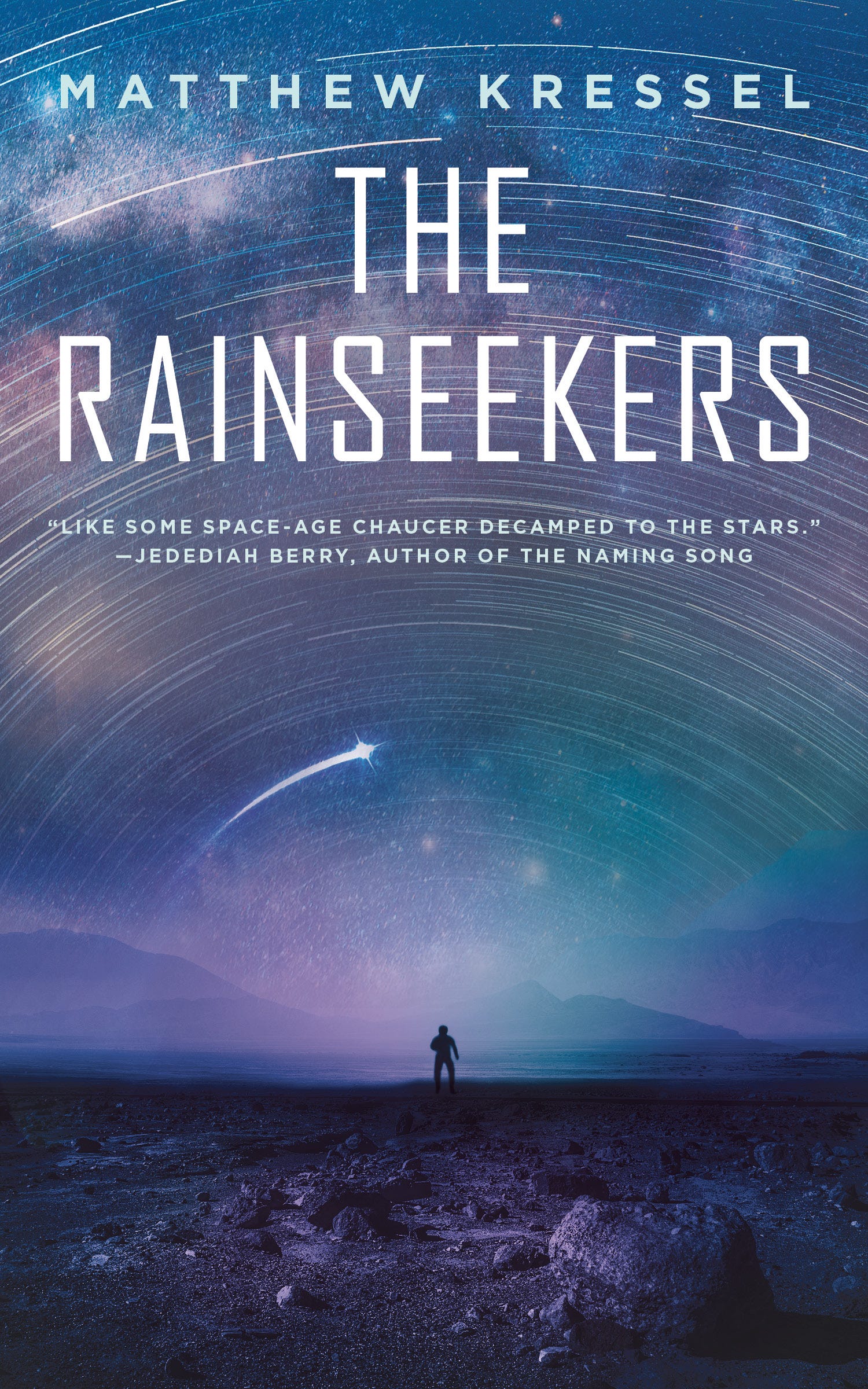
The Rainseekers is available at your favorite bookstore. Thank you!
Most people assume the “web” and the “net” i.e. internet are the same. But in actuality, the web is just one part of the internet, specifically a series of connection protocols called HTTP or Hypertext Transmission Protocol, where you get the “http://” prefix in URLs, and these connections usually exist on TCP/IP ports 80 and 443, but they don’t have to. There are many other “services” running on the internet using different port numbers, the most common being email, which uses a series of ports, including, 25, 110, 465, 587, 993, etc.
I never use AI in these posts and I never will.
Email may be the only online medium not yet filtered, but with AI agents coming for your inbox, I expect that to soon change.
Yeah, I know Substack has its own issues, and I’ve been criticized for using it. But those same people who criticize me for using Substack continue to use X/Twitter, Facebook, Threads, Instagram, TikTok, and others, all of which have had or continue to have the same problem. The issue is that all these mediums are corporate owned, and so we don’t have full control over our own feed and content. And, for the record, I have tried federated social media like Mastodon, and I just don’t think it has enough users to be useful, and it’s too hard for a novice to set up.