
Fiction and Radical Honesty
We have to strive for personal authenticity if we want to say something meaningful

I have been listening to recordings of old Bookworm radio shows. Bookworm was a nationally syndicated radio program discussing literature hosted by the recently deceased Michael Silverblatt. One of Silverblatt’s repeat guests was the late David Foster Wallace, the author of Brief Interviews with Hideous Men, and Infinite Jest, and Oblivion, among many others. The interviews were recorded in the late 90s, and what struck me in one of the episodes was at one point the conversation turned toward this notion of authorial self-consciousness. Wallace postulated that the author, in his era of the 90s, has become hyper-aware of how he is perceived by the reader, and in turn how the reader perceives him, and the reader knows this, and he knows the reader knows this, ad infinitum, and thus he tailors his words with this knowledge in mind.
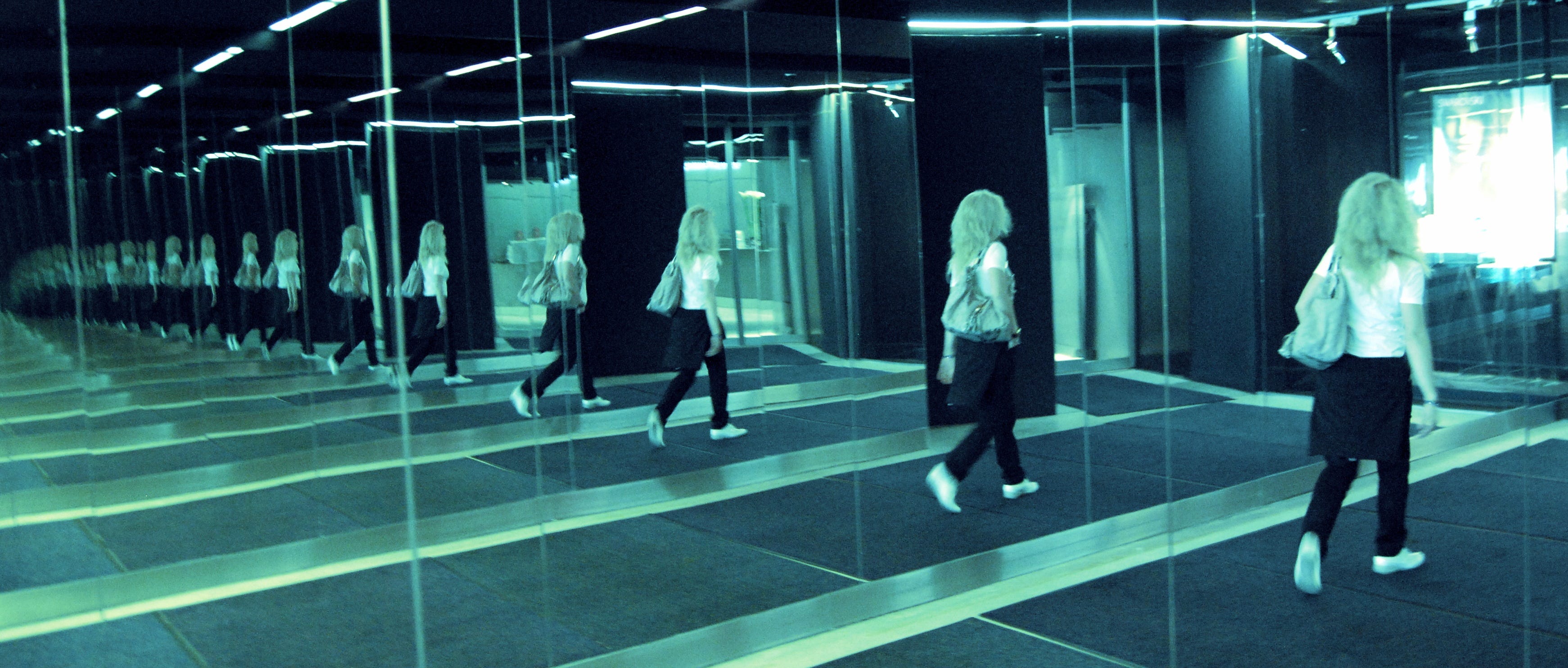
I imagined it like an infinite regressive spiral, a funhouse mirror or a barber’s chair, where the mirror images are reflected back on themselves forever. This sort of extreme self-awareness, which led to a kind of mock self-deprecation so prevalent in Wallace’s fiction and others — a kind of “haha, I’m a stupid author, don’t trust a word I’m saying, but if you do trust me for a moment, I’ll say something witty and profound that you didn’t consider, haha” — this sort of hyper self-awareness seems to be an effect of our modern digital age.
It occurred to me that before the 90s, before the internet strode into every home, unless you were an author, a journalist, or a politician, unless you had a job whose responsibilities included speaking to large groups of people, almost everyone you interacted with during the day was someone you knew. When you wake up, you interact with your parents or your spouse or your children. During the day it might be your classmates or your work colleagues. After work it might be friends at a bar, or a workout buddy. You might interact with a few strangers here and there during the day, but almost every interaction, save perhaps for some phone calls, were face to face, with someone you know.
Then along comes the internet, and now all of a sudden you can communicate with total strangers across the globe. First through text, in email and old forums like Usenet, then later via YouTube and TikTok and all social media. And because in these media you are potentially interacting with a huge number of strangers, many of whom you will never meet in person, there’s a change in rhetoric.
Like writers and politicians and others in the pre-digital age, you have now become conscious of how you appear to strangers, and they in turn become conscious that you are tailoring your words for them, and they know you know this, and you know they know this, and thus the same posturing affect that politicians and authors and others have used in the past, what is sometimes called rhetoric, is now adopted by everyone interacting online. Everyone has become hyperconscious of how they appear to others.
I don’t think this is new, necessarily, because people were conscious of how they appeared to others long before the internet. But this awareness was localized, for most people, to those we interacted with personally. Now, with the internet, this has been globalized to anyone, anywhere, with an online account.
And the sort of troubling thing I see happening is that, for most people, especially young folks, a large part of their day, even a majority of their day, is spent interacting with people online whom they will never meet.
So whereas before you might consider how you appear to the fifty people you interacted with personally on any single day, now you consider how you appear to potentially thousands of people whom you will never meet.
You will not even know their names.
This has led to, I think, an epidemic of people putting their “highlight reels” online, a pageant display of your best moments, trying to project to the world how good and wonderful your life is. And because, for some of us, our online “interactions” are more common and frequent than our offline ones, more common than our personal interactions with real people, we come to believe this online projection of ourselves is the real “me.”
This is one definition of narcissism: identifying with our projections, becoming so hyperaware of how you appear to others that you believe yourself to be that image. You identify with this projected image of yourself, because either you don’t know your true self or you feel your real self too inferior, and so you repress it. I am not “this,” I am “that.”
This is what the blogger The Last Psychiatrist wrote about. His writing is often acerbic, but his intent, I think, is to wake the reader up to their own narcissism and projections. And some of his insights are profound.
I think Wallace was a writer on the cusp of this sea change in self-awareness, this shift from being conscious of how we appear to those we personally know, to being conscious of how we appear to those we don’t and will never know. As a self-aware writer documenting in Infinite Jest and elsewhere the dehumanizing effect of technology on us, he was perfectly positioned to highlight this rhetorical change.
Because this projection, this image we put out to the world, this persona we want others to see and believe, is just that: an image. It isn’t real. The real self lies either hidden or undiscovered.
Personally, I have been guilty of all of the above: posturing, projecting, narcissism. And I have discovered that the only way out of this funhouse mirror of projection and infinite regressive awareness of self and other is to not give a fuck.
What I mean is, we have to cultivate radical honesty. We have to not care or think about how others will perceive us. We have to stop considering this amorphous blob of anonymous faces scrutinizing our works and our image. We have to write our truths down how we see them, not how we want to be seen.
We have to strive for authenticity. We have to seek out what we feel, what we think, what we want. We have to turn off the projector. We have to stop considering how will this make me look? And instead consider, What is it that I really want to express?
This is incredibly hard to do, especially if you’re young, because corporations have been programming you with wants since before you could talk.
But the fiction I want to read, the art I want to enjoy, is free from these projections, free from the scourge of persona, and examines deeper truths with radical honesty and an unflinching lens.
I don’t know if any work can be totally free of these things, but at least in my own work, especially in my latest, I try.
If you like these posts and you would like to support my writing, please consider buying one or more of my books. My novella The Rainseekers is out now.
The Rainseekers - “A vivid, poignant, and compassionate story about our desperate search for meaning...whether on Earth or far beyond it.” —Veronica Roth, New York Times bestselling author of the Divergent series
Space Trucker Jess - “A page-turning adventure set in an inventive universe” –Publishers Weekly
Histories Within Us - 2025 Locus Recommended Reading List, “A dazzling collection” –A.C. Wise
Dispatches from the Outer Deep - A Guide to Writing, Editing, Submitting, and Publishing Long and Short Fiction.